
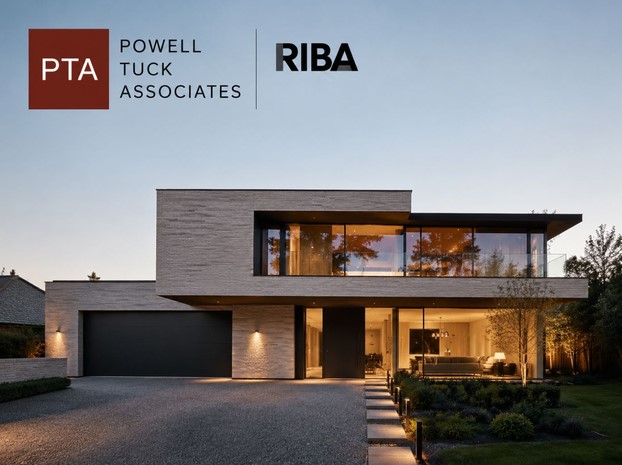
Highlever House by Powell Tuck Associates — the result of a fully coordinated RIBA process.
Embarking on a major home renovation or a new-build can feel exhilarating and overwhelming in equal measure. You have a vision, perhaps a budget, and a plot of land or a tired property crying out for transformation. But how does a sketch on the back of a napkin become a finished home you can live in? The answer lies in a clear, internationally respected framework: the RIBA Plan of Work. In this guide we have the RIBA stages explained in plain English, so you can walk into your first design meeting with confidence.
At Powell Tuck Associates, we guide homeowners through every step of this journey — from the very first conversation to the moment you turn the key. Understanding the RIBA work stages demystifies the architectural design process and helps you make informed decisions about time, money and design at exactly the right moments.
What Is the RIBA Plan of Work?
The RIBA Plan of Work is the UK construction industry’s definitive roadmap, published by the Royal Institute of British Architects. First created in 1963 and most recently refreshed in 2020, it breaks any building project — from a modest rear extension to a sprawling country house — into eight clearly defined stages, numbered 0 to 7.
Think of it as a shared language. When your architect, structural engineer, contractor and planning consultant all reference the same stages, everyone knows precisely where the project stands, what has been agreed and what comes next. For homeowners, this transparency is invaluable: it turns an intimidating concept to completion architecture journey into a series of manageable, predictable steps.
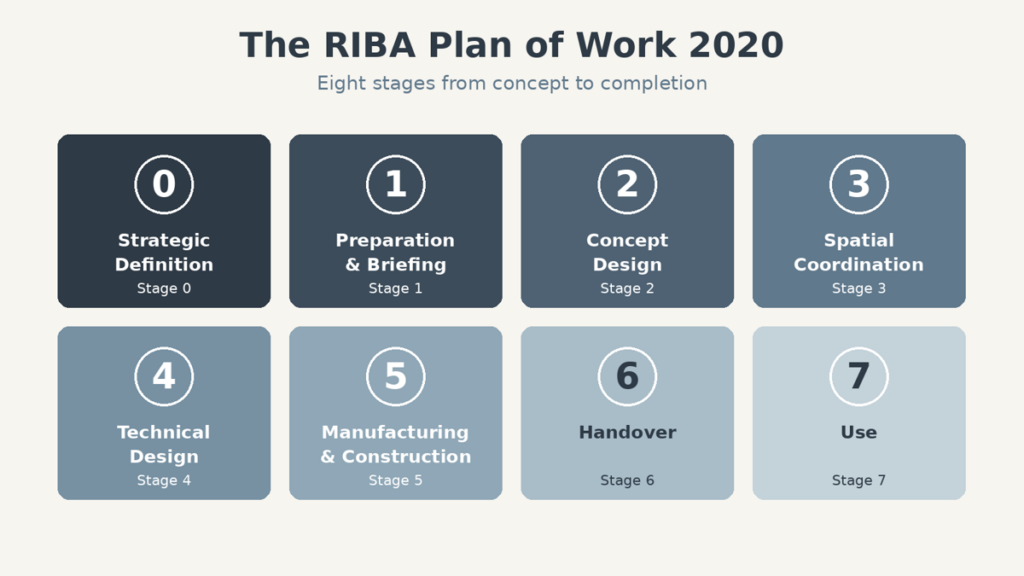
The eight RIBA stages, from Strategic Definition (0) to Use (7).
What Are the 7 RIBA Stages?
A common question is whether there are seven or eight RIBA stages. The 2020 Plan of Work actually runs from Stage 0 to Stage 7 — eight stages in total — but because Stage 0 is a strategic, pre-design step, many homeowners think of the journey as the “seven” active project stages. Here is the full picture at a glance:
- Stage 0 – Strategic Definition: deciding whether the project is the right way to meet your needs.
- Stage 1 – Preparation and Briefing: setting the brief, budget and project team.
- Stage 2 – Concept Design: the creative sketch design phase.
- Stage 3 – Spatial Coordination: refining and coordinating the design, usually with a planning application.
- Stage 4 – Technical Design: detailed drawings for construction.
- Stage 5 – Manufacturing and Construction: building work on site.
- Stage 6 – Handover: completion and handing over the finished building.
- Stage 7 – Use: living in and maintaining your home.
Below, we walk through each stage in the order you will experience it — with practical strategies and real-world examples drawn from our London studio.
Stages 0 & 1: Strategic Definition, Preparation and Briefing
Every successful project begins long before a single line is drawn. Stage 0 asks the most important question of all: is building actually the best way to achieve what you want? Sometimes a clever reconfiguration beats a costly extension. Stage 1 then turns that decision into a concrete brief — your wish list, your budget, your timescale and the appointment of your design team.
Practical strategy
Write down your “must-haves” and “nice-to-haves” separately, and be honest about your budget from day one. A realistic brief prevents expensive redesigns later. For example, a Camden family who came to us wanting “more light and space” discovered during briefing that their real priority was a better connection to the garden — a clarity that shaped every decision that followed.
Stage 2: Concept Design — The Sketch Design Phase
This is where your project comes alive. At Stage 2, your architect develops the initial design concept: the look, the feel, the spatial arrangement and the relationship between rooms, light and the outdoors. You will see sketches, sometimes 3D models, and the first real sense of how your home could be.
Concept design is deliberately exploratory. Expect to review two or three options and give feedback. It is far cheaper to move a wall on paper than on site, so this is the moment to be candid about what excites you and what does not.
Real-world example
For our Deep Water project, the concept stage was about marrying a bold modern form with the qualities of the site. The client later described the finished home as “unmistakably mine” — proof that a strong concept, agreed early, carries right through to completion.
What Is RIBA Stage 3?
RIBA Stage 3 is Spatial Coordination, and it is one of the most pivotal points in the architectural design process. Here, the agreed concept is developed and coordinated in three dimensions. Your architect works with structural engineers and other consultants to make sure everything fits together — the structure, the layout, the services — before any detailed construction information is produced.
Crucially, Stage 3 is usually when your planning application is submitted to the local authority. Because planning decisions typically take at least eight weeks, this stage often includes a natural pause while you await a decision. It is a normal, expected part of the journey rather than a delay.
Practical strategy
Use the planning waiting period productively. Start gathering inspiration for fixtures, finishes and fittings so that when the design moves into technical detailing, your choices are ready. If you would like to see how thoughtful coordination translates into built work, explore our portfolio of projects.
What Is the Difference Between RIBA Stage 4 and 5?
This is one of the most frequently asked questions, and the distinction is straightforward once you see it. Stage 4 is Technical Design — it happens on paper (or screen). Stage 5 is Manufacturing and Construction — it happens on site. In short, Stage 4 is about finalising every detail of how the building will be made; Stage 5 is about actually making it.
Stage 4: Technical Design
At Stage 4, the design is translated into precise, buildable information: detailed drawings, specifications and input from structural and services engineers. This is where decisions about materials, junctions, insulation and finishes are locked down. A well-resolved Stage 4 reduces costly surprises and variations once building begins.
Stage 5: Manufacturing and Construction
Stage 5 is the build itself. Components are manufactured, the contractor mobilises, and your design becomes a physical reality. Your architect can remain involved to administer the building contract, inspect quality and answer queries as they arise on site — keeping the finished result faithful to the design you approved.
Careful technical design at Stage 4 lays the groundwork for a smooth construction phase.
Stages 6 & 7: Handover and Use
At Stage 6 – Handover, the building is complete and handed over to you. This stage covers the final snagging (fixing minor defects), the issuing of completion certificates and the practical business of moving in. A good handover includes clear guidance on how to operate and maintain your new home.
Stage 7 – Use begins the moment you move in and lasts for the life of the building. Increasingly, the 2020 Plan of Work emphasises checking that the home performs as intended — particularly its energy and sustainability targets — so it continues to serve you beautifully for years to come.
How Long Does Each RIBA Stage Take?
There is no single answer, because every project is unique. A compact extension might race through the early stages, while a listed building or a complex new-build will need more time for design and approvals. That said, the following timeline gives homeowners a realistic sense of the RIBA work stages from start to finish.
| RIBA Stage | Typical Duration | What Drives the Timeline |
| Stages 0–1: Definition & Briefing | 2–6 weeks | Clarity of the brief and budget |
| Stage 2: Concept Design | 4–8 weeks | Design complexity, client feedback |
| Stage 3: Spatial Coordination | 6–12 weeks | Planning application (8+ weeks) |
| Stage 4: Technical Design | 6–10 weeks | Engineering and detailing |
| Stage 5: Construction | 6–18 months | Scope, site and contractor |
| Stage 6: Handover | 1–4 weeks | Snagging and sign-off |
Note: durations are indicative. Your architect will give you a tailored programme during Stage 1.
Frequently Asked Questions
What are the 7 RIBA stages?
The RIBA Plan of Work 2020 has eight stages (0–7): Strategic Definition, Preparation and Briefing, Concept Design, Spatial Coordination, Technical Design, Manufacturing and Construction, Handover, and Use. Many homeowners refer to the “seven” active project stages because Stage 0 is a pre-design, strategic step.
What is RIBA Stage 3?
RIBA Stage 3 is Spatial Coordination. The agreed concept is refined and coordinated across all disciplines — architecture, structure and services — and the planning application is typically submitted at this point.
What is the difference between RIBA Stage 4 and 5?
Stage 4 (Technical Design) finalises all the detailed drawings and specifications needed to build, while Stage 5 (Manufacturing and Construction) is the physical building work on site. Stage 4 happens on paper; Stage 5 happens on the ground.
How long does each RIBA stage take?
It varies by project. Early design stages often take a few weeks each, the planning stage adds around eight weeks or more, and construction can run from several months to over a year. Your architect will set out a bespoke programme at the briefing stage.
Conclusion: Your Vision, Expertly Guided
Understanding the RIBA stages explained here transforms a daunting prospect into a clear, confident journey. From the first strategic conversation to the day you settle into your finished home, each stage exists to protect your time, your budget and — above all — your vision. The framework brings order to creativity, ensuring nothing is overlooked on the path from concept to completion.
At Powell Tuck Associates, we combine craftsmanship, creativity and practicality to guide homeowners through every RIBA stage with care. If you are ready to turn your sketch design into a home you will love, we would be delighted to help. Get in touch with our London studio to start the conversation, or browse our practice and approach to learn more about how we work.